

NDC COORDINATION AND IMPLEMENTATION FORUM
Education & Resources
The transition to the 12-digit NDC will affect systems, standards, data, and workflows across the healthcare ecosystem. This resource library brings together educational materials from the NDC Forum and relevant resources from government agencies, standards organizations, trade associations, and other implementation partners to help stakeholders understand the change, follow key developments, assess potential impacts, and prepare for implementation.
To submit resources for consideration please send a link to the resource with a very brief summary (no more than 3 sentences) to NDCForum@leavittpartners.com.
Rule Overview
About the National Drug Code
National Drug Code (NDC) is FDA’s standard for uniquely identifying prescription and over-the-counter drugs marketed in the U.S.[1] The Federal Food Drug & Cosmetic Act (21 USC Chapter 9) requires all drugs to be registered and listed. Via regulations (21 CFR 207.49) drugs are required to be identified and listed using the NDC.
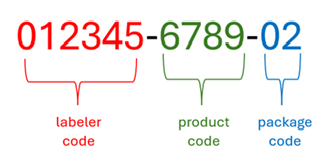
NDC codes consist of 3 segments.
Labeler code – IDs manufacturer, repacker, relabeler, or private label distributor
Product code – IDs active ingredient, strength, dosage form, and other distinguishing characteristics of a drug
Package code – IDs package size and type
Currently, three different configurations are permitted, 4-4-2, 5-3-2, and 5-4-1. Additionally, HIPAA regulations require NDCs follow an 11-digit (5-4-2) format for billing purposes. This causes confusion particularly when the NDC is listed without dashes. Additionally, there are only 90,000 labeler codes, and based on current assignment rates, FDA anticipates it will run out of 5-digit labeler codes in approximately 10 years.
[1] Alternative formats are permitted for human cells, tissues, and cellular and tissue-based products (HCT/Ps).
About the FDA Final Rule
History
Nov. 5, 2018: FDA held a public hearing on the Future Format of the National Drug Code
July 22, 2022: FDA published a proposed rule
March 5, 2026: FDA published a final rule, Revising the National Drug Code Format and Drug Label Barcode Requirements
On March 5, 2026, FDA published the final rule which has 2 main components:
First, the final rule requires a new, uniform 12-digit format for NDCs effective on March 7, 2033, to account for the soon to be exhausted finite number of labeler codes. The new uniform format will replace the current mix of 10-digit configurations.
Labeler code (4 or 5 to 6 digits)
Product code (3 or 4 to 4 digits)
Package code (1 or 2 to 2 digits)
On March 7, 2033, FDA will automatically convert current 10-digit NDCs by adding leading zeros to get the new 6-4-2 format.
The change from 5 to 6 digits will add 900,000 labeler codes which FDA estimates will last 900 years. Furthermore, moving to a single, uniform 12-digit format will improve efficiencies and patient safety by reducing errors
The final rule also permits greater flexibility to the bar code labeling requirements by allowing for a linear or 2D bar code that conforms to widely recognized international standards and in an FDA recognized format. FDA subsequently confirmed that the 2D bar code required by the Drug Supply Chain Security Act (DSCSA) can be used to satisfy this requirement.
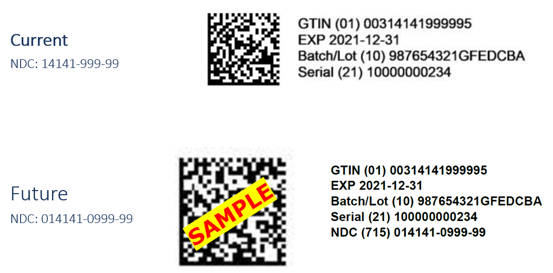
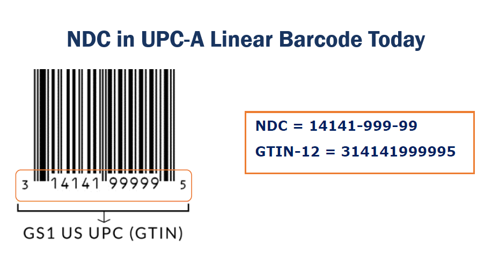
Currently, the NDC is embedded into a global trade item number (GTIN) encoded in a linear bar code. The 12-digit NDC will no longer fit. Therefore, the new NDC format will force a decoupling of the NDC and GTIN.
And current 2D barcodes will go from 4 elements to 5.
Image credit: https://www.gs1us.org/
Barcode updates will accommodate advancements in technology and industry needs by providing more options. The update will also reduce errors when scanning is not possible and must be manually entered, thus improving patient safety.

Timeline
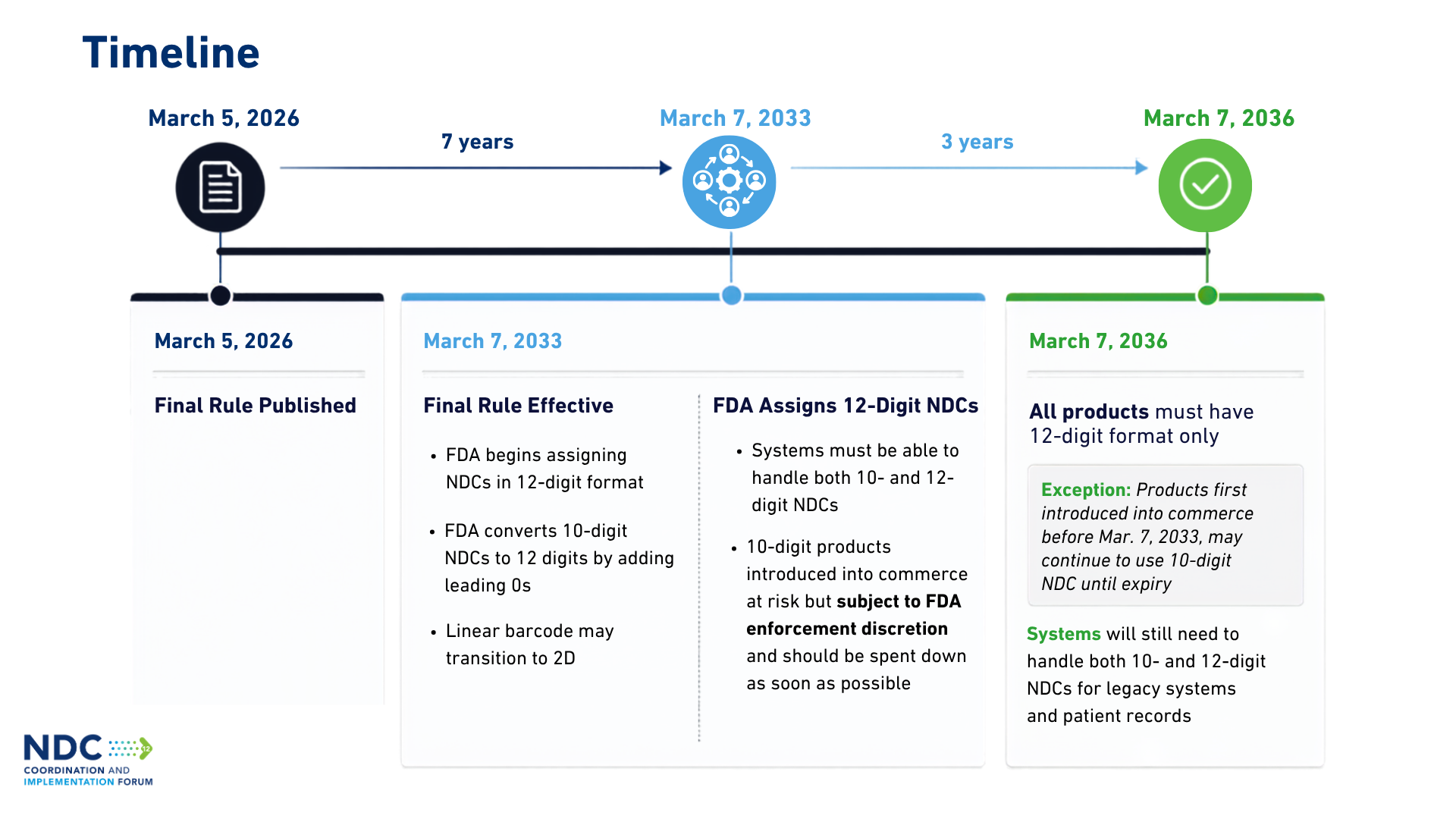
Because of the operational complexity to implement this rule, FDA has provided a 7-year lead time before the rule takes effect on Mar 7, 2033. On that date, FDA will automatically convert all 10-digit NDCs to 12 digits by adding leading 0s. FDA will begin assigning 12-digit NDCs going forward. Linear bar codes will be able to transition to 2D.
From March 7, 2033 through March 6, 2036, there will be a three-year transition period to allow time to complete label updates and deplete old 10-digit labeling stock and during which FDA has indicated it does not intend to object to continued use of 10-digit NDCs on drug labels. However, companies should begin updating their labeling as soon as possible to the 12-digit NDCs by adding the necessary leading zeros and start labeling products with the 12-digit NDC as soon as possible once the transition period begins on March 7, 2033. Drugs labeled with a 10-digit NDC after March 7, 2036 may be subject to regulatory actions.
FAQs
Will the 10 to 12-digit conversion be considered a “new” NDC for purposes of drug registration and listing? No, FDA states in the final rule that it considers the conversion of a 10-digit NDC to a 12- digit NDC format to be a ministerial, administrative change. FDA will automatically convert 10-digit NDCs to 12 digits by adding leading zeros in some segments on the effective date of March 7, 2033. Furthermore, FDA considers such an NDC in its original 10-digit format and in its converted 12-digit format to be the same NDC with different formats.
How will the crosswalk between 10- and 12-digit NDCs be communicated? FDA intends to publish a database that will map each 10-digit NDC appearing in the NDC Directory to the corresponding 12- digit NDC at least until the end of the transition period. Compendia also are expected to update their databases.
How will manufacturers report updates to their labeling and packaging? Manufacturers must report that they have updated a product label to reflect the 12-digit NDC by using the annual reporting process as outlined in federal regulations and update the relevant structured product labeling (SPL) electronic listing file with the new labels and packaging.[1,2]
When should firms begin labeling products with 12-digit NDCs? Firms should start labeling products with 12-digit NDCs as soon as possible after the effective date of March 7, 2033, and no later than when existing labeling stock is depleted.
What relevant issues are outside of FDA’s scope but will need to be addressed? There are several relevant issues that are outside of FDA’s scope which will need to be addressed for effective implementation. These include GTINs, HIPAA’s 11-digit NDC standards, and handing historical patient records.
What type of entities will be impacted by the NDC transition? Nearly every part of the health care ecosystem will be impacted from manufacturers, wholesalers & distributors, packagers, labelers, importers, providers, pharmacists, hospitals, payers, retailers, EHRs, e-prescribers, dentists, long-term care, and federal, state, and local entities.
The NDC forum will serve a key role in keeping stakeholders informed and updated on these and many other critical elements for a successful implementation.
[1] 21 CFR 314.81(b)(2)(iii) for drugs subject to a new drug application (NDA) or abbreviated new drug application (ANDA) or 21 CFR 601.12(f)(3) for biological products subject to a biologics license application (BLA). Manufacturers that voluntarily include the NDC on the label of an animal drug must make a similar report in accordance with 21 CFR 514.80(b)(4)(ii).
[2]In accordance with § 207.49(a)(15).
Resources
FDA: National Drug Code Format
Best overview of the new format, timelines, leading-zero conversion, labeling, systems, barcodes, and exceptions.Federal Register: Final Rule
Authoritative legal text, including requirements, effective dates, transition rules, and FDA responses to stakeholder comments.FDA: Final Regulatory Impact Analysis
Explains the rationale for the change, expected benefits, affected organizations, and estimated implementation costs.FDA: Proposed Rule Background
Provides historical context on current NDC structures and the original policy rationale.FDA: Drug Registration and Listing System
Relevant for manufacturers and registrants managing drug-listing files and Structured Product Labeling.
Cracking the New National Drug Code Format — FDLI, September 24, 2026
This is highly relevant and specifically addresses the final rule, labeling, data retention, and supply-chain impacts—but as of September 16, 2026, it is an upcoming live webinar rather than a completed recording.Pharmaceutical Commerce: Why Your NDC-12 Roadmap Should Start Now
Repository
FDA Documents and Announcements
FDA Final Rule. Revising the National Drug Code Format and Drug Label Barcode Requirements.
FDA webpage: National Drug Code Format
Webinars & Presentations
Leavitt Partners webinar: Impact and Implementation of the NDC Final Rule Across the Health Care Industry. June 17, 2026.
This website and its content do not constitute and are not intended to represent legal advice. The materials herein are based on an evolving understanding of the NDC final rule requirements. Companies should consult with their legal counsel, regulatory compliance specialists and trading partners for further guidance on implementation.