

NDC COORDINATION AND IMPLEMENTATION FORUM
Education & Resources
The transition to the 12-digit NDC will affect systems, standards, data, and workflows across the healthcare ecosystem. This resource library brings together educational materials from the NDC Forum and relevant resources from government agencies, standards organizations, trade associations, and other implementation partners to help stakeholders understand the change, follow key developments, assess potential impacts, and prepare for implementation.
To submit resources for consideration please send a link to the resource with a very brief summary (no more than 3 sentences) to NDCForum@leavittpartners.com.
Rule Overview
About the National Drug Code
National Drug Code (NDC) is FDA’s standard for uniquely identifying prescription and over-the-counter drugs marketed in the U.S.[1] The Federal Food Drug & Cosmetic Act (21 USC Chapter 9) requires all drugs to be registered and listed. Via regulations (21 CFR 207.49) drugs are required to be identified and listed using the NDC.
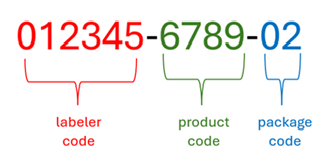
NDC codes consist of 3 segments.
Labeler code – IDs manufacturer, repacker, relabeler, or private label distributor
Product code – IDs active ingredient, strength, dosage form, and other distinguishing characteristics of a drug
Package code – IDs package size and type
Currently, three different configurations are permitted, 4-4-2, 5-3-2, and 5-4-1. Additionally, HIPAA regulations require NDCs follow an 11-digit (5-4-2) format for billing purposes. This causes confusion particularly when the NDC is listed without dashes. Additionally, there are only 90,000 labeler codes, and based on current assignment rates, FDA anticipates it will run out of 5-digit labeler codes in approximately 10 years.
[1] Alternative formats are permitted for human cells, tissues, and cellular and tissue-based products (HCT/Ps).
About the FDA Final Rule
History
Nov. 5, 2018: FDA held a public hearing on the Future Format of the National Drug Code
July 22, 2022: FDA published a proposed rule
March 5, 2026: FDA published a final rule, Revising the National Drug Code Format and Drug Label Barcode Requirements
On March 5, 2026, FDA published the final rule which has 2 main components:
First, the final rule requires a new, uniform 12-digit format for NDCs effective on March 7, 2033, to account for the soon to be exhausted finite number of labeler codes. The new uniform format will replace the current mix of 10-digit configurations.
Labeler code (4 or 5 to 6 digits)
Product code (3 or 4 to 4 digits)
Package code (1 or 2 to 2 digits)
On March 7, 2033, FDA will automatically convert current 10-digit NDCs by adding leading zeros to get the new 6-4-2 format.
The change from 5 to 6 digits will add 900,000 labeler codes which FDA estimates will last 900 years. Furthermore, moving to a single, uniform 12-digit format will improve efficiencies and patient safety by reducing errors
The final rule also permits greater flexibility to the bar code labeling requirements by allowing for a linear or 2D bar code that conforms to widely recognized international standards and in an FDA recognized format. FDA subsequently confirmed that the 2D bar code required by the Drug Supply Chain Security Act (DSCSA) can be used to satisfy this requirement.
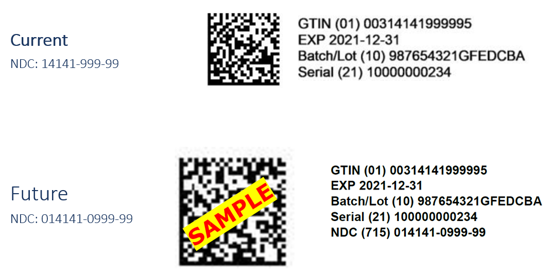
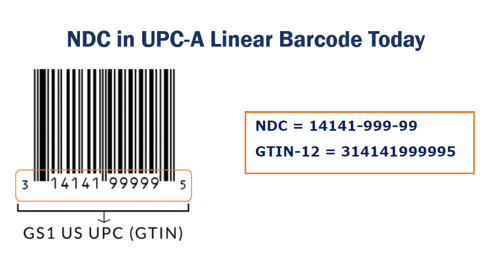
Currently, the NDC is embedded into a global trade item number (GTIN) encoded in a linear bar code. The 12-digit NDC will no longer fit. Therefore, the new NDC format will force a decoupling of the NDC and GTIN.
And current 2D barcodes will go from 4 elements to 5.
Image credit: https://www.gs1us.org/
Barcode updates will accommodate advancements in technology and industry needs by providing more options. The update will also reduce errors when scanning is not possible and must be manually entered, thus improving patient safety.

Timeline
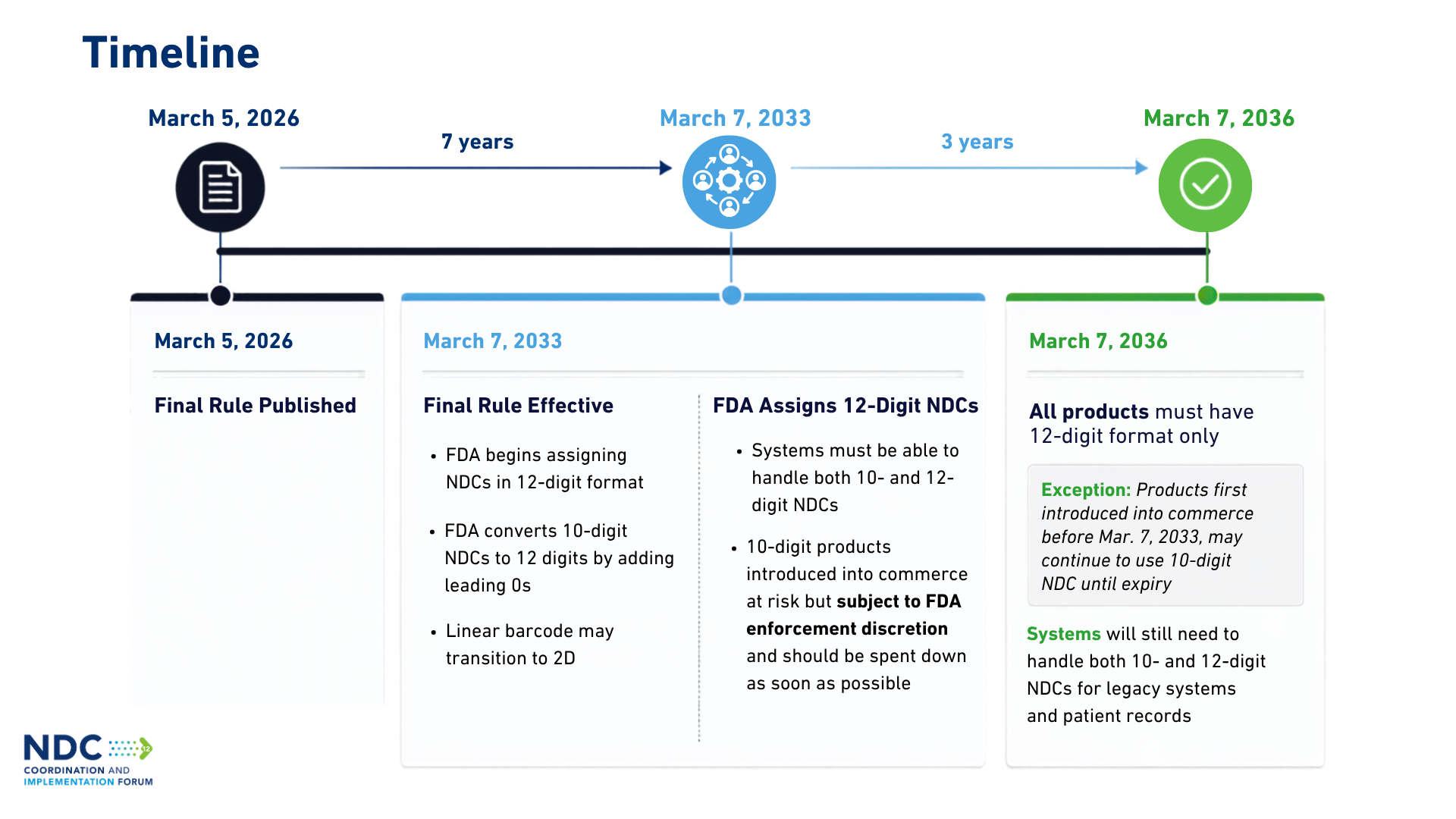
Because of the operational complexity to implement this rule, FDA has provided a 7-year lead time before the rule takes effect on Mar 7, 2033. On that date, FDA will automatically convert all 10-digit NDCs to 12 digits by adding leading 0s. FDA will begin assigning 12-digit NDCs going forward. Linear bar codes will be able to transition to 2D.
From March 7, 2033 through March 6, 2036, there will be a three-year transition period to allow time to complete label updates and deplete old 10-digit labeling stock and during which FDA has indicated it does not intend to object to continued use of 10-digit NDCs on drug labels. However, companies should begin updating their labeling as soon as possible to the 12-digit NDCs by adding the necessary leading zeros and start labeling products with the 12-digit NDC as soon as possible once the transition period begins on March 7, 2033. Drugs labeled with a 10-digit NDC after March 7, 2036 may be subject to regulatory actions.
FAQs
-
When may manufacturers begin using the 12-digit NDC format?
March 7, 2033. Until then, FDA will continue assigning 10-digit NDCs. Manufacturers may prepare revised labels and packaging prior to March 7, 2023, but the new 12-digit labeling should not be introduced into commerce before the effective date. Manufacturers need to plan and manage their inventories carefully to ensure product labeled with 12-digit NDCs is not introduced into commerce before March 7, 2033 and simultaneously limiting, to the extent reasonable, the volume 10-digit product that is introduced after March 7, 2033.
What type of entities will be impacted by the NDC transition?
Nearly every part of the health care ecosystem will be impacted from manufacturers, wholesalers & distributors, packagers, labelers, importers, providers, pharmacists, hospitals, payers, retailers, EHRs, e-prescribers, dentists, long-term care, and federal, state, and local entities.
What drugs are affected?
Any drug subject to drug-listing requirements and assigned FDA NDCs will be affected. This includes human prescription drugs, human over-the-counter drugs, and animal drugs.
Are active pharmaceutical ingredients affected?
Yes, when subject to drug-listing requirements and assigned FDA NDCs. The rule’s discussion recognizes NDCs for bulk APIs and bulk intermediates. FDA’s September 2, 2026 presentation, “Preparing for NDC and Barcode Modernization,” states that the rule applies to finished and unfinished drugs.
-
During the transition period, may manufacturers continue introducing products labeled with 10-digit NDCs into interstate commerce?
Yes, FDA does not intend to object to the continued use of 10-digit NDCs on drug labels during the transition period, but companies should update their labeling as soon as possible to replace the 10-digit NDC format with the new 12-digit NDC format.
Products delivered for introduction into interstate commerce with a 10-digit NDC after the effective date and before the end of the transition period are subject to enforcement action if still in commerce on or after March 7, 2036.
Products delivered for introduction into interstate commerce with a 10-digit NDC before the effective date may remain in commerce until expiry.
How should products packaged before March 7, 2033, but introduced into interstate commerce afterward, be handled?
The transition period is based on when the product is “delivered for introduction into interstate commerce.” The Final Rule clarifies that packaging alone does not constitute delivery for introduction into interstate commerce. If delivered for introduction into interstate commerce with a 10-digit NDC on/after March 7, 2033, the product may remain during the transition but may face enforcement if still in commerce on March 7, 2036.
May a manufacturer sell a 10-digit-labeled product to a distributor through the final day of the transition period?
Not strictly prohibited, but high risk. FDA does not intend to object to continued introduction of 10-digit NDC labeling during the transition period. However, drugs delivered for introduction into interstate commerce on/after March 7, 2033 may only remain on the market until March 7, 2036. A product sold to a distributor at or near the end of the transition is likely to still be in the supply chain after that date, so firms should plan to stop introducing 10-digit-labeled product well before the transition ends.
FDA expects 10-digit labeling mainly in the first transition year as firms use up existing labeling stock, and most firms to be using 12-digit labeling by the second year. Firms still using 10-digit labeling in the third year are at risk for enforcement if those products remain on the market after the transition ends.
Who must identify and address remaining 10-digit inventory?
The final rule does not assign this responsibility to a single entity. FDA established the three-year transition period, March 7, 2033 through March 6, 2036, to allow companies to update labeling and deplete existing labeling stock. FDA does not intend to object to continued use of 10-digit NDCs on drug labels during that transition period and states that drugs labeled with a 10-digit NDC after March 7, 2036 may be subject to regulatory action.
The rule does not prescribe an industry-wide process for identifying, removing, returning, relabeling, or destroying remaining 10-digit-labeled inventory. Therefore, manufacturers, distributors, wholesalers, pharmacies, and other supply-chain participants will need to determine how remaining inventory is identified and managed based on their respective regulatory responsibilities, contractual arrangements, and operational processes.
-
How will existing labeler codes be treated?
Existing labeler codes of fewer than six digits will be converted to six digits by adding leading zeros. The leading zeros become part of the NDC and should not be truncated. Beginning March 7, 2033, FDA will issue new six-digit labeler codes starting at 100000; new six-digit labeler codes beginning with zero will not be issued.
How will manufacturers report updates to their labeling and packaging?
Manufacturers must report that they have updated a product label to reflect the 12-digit NDC by using the annual reporting process as outlined in federal regulations and update the relevant structured product labeling (SPL) electronic listing file with the new labels and packaging. [1,2]
[1] 21 CFR 314.81(b)(2)(iii) for drugs subject to a new drug application (NDA) or abbreviated new drug application (ANDA) or 21 CFR 601.12(f)(3) for biological products subject to a biologics license application (BLA). Manufacturers that voluntarily include the NDC on the label of an animal drug must make a similar report in accordance with 21 CFR 514.80(b)(4)(ii).
[2] In accordance with § 207.49(a)(15).
How will the change affect UDI listings?
The NDC final rule does not address how the transition to the 12-digit NDC will affect UDI records, GUDID submissions, or combination-product records. UDI and GUDID requirements are governed separately under 21 CFR parts 801 and 830. FDA has separate guidance addressing UDI requirements for combination products, but it does not establish an NDC-12-specific process for updating UDI or GUDID records.
-
What does “subject to enforcement” mean after March 7, 2036?
FDA has not specified a particular enforcement action that will automatically occur after the transition period. FDA states that drugs labeled with a 10-digit NDC after March 7, 2036 may be subject to regulatory action. Failure to comply with applicable drug-labeling requirements can result in a drug being considered misbranded under the Federal Food, Drug, and Cosmetic Act (Section 502), which may lead to FDA enforcement actions such as warning letters, seizure, or injunctions depending on the circumstances.
Which entities will be subject to enforcement?
FDA’s NDC requirements are tied to the drug registration, listing, and labeling requirements under Section 510 of the Food, Drug, and Cosmetic Act and 21 CFR Parts 207 and 201. Accordingly, FDA enforcement for failure to comply with the new NDC format would primarily apply to establishments and parties responsible for drug listing and labeling that fail to comply with the new 12-digit NDC requirements. The rule applies to FDA-assigned NDCs for human drugs, biological products, and animal drugs. It does not establish the same NDC-format compliance obligation for every downstream entity that uses an NDC, such as pharmacies, hospitals, wholesalers, payers, and other health care organizations. Those entities will need to update their systems to accommodate the 12-digit NDC, but their obligations may arise from other regulatory, contractual, transaction, or operational requirements rather than FDA's NDC labeling enforcement.[1]
[1] U.S. Food and Drug Administration. “Labeling Requirements - Misbranding.” October 27, 2017. FDA.
Resources
FDA: National Drug Code Format
Best overview of the new format, timelines, leading-zero conversion, labeling, systems, barcodes, and exceptions.Federal Register: Final Rule
Authoritative legal text, including requirements, effective dates, transition rules, and FDA responses to stakeholder comments.FDA: Final Regulatory Impact Analysis
Explains the rationale for the change, expected benefits, affected organizations, and estimated implementation costs.FDA: Proposed Rule Background
Provides historical context on current NDC structures and the original policy rationale.FDA: Drug Registration and Listing System
Relevant for manufacturers and registrants managing drug-listing files and Structured Product Labeling.
Cracking the New National Drug Code Format — FDLI, September 24, 2026
This is highly relevant and specifically addresses the final rule, labeling, data retention, and supply-chain impacts—but as of September 16, 2026, it is an upcoming live webinar rather than a completed recording.Pharmaceutical Commerce: Why Your NDC-12 Roadmap Should Start Now
Repository
FDA Documents and Announcements
FDA Final Rule. Revising the National Drug Code Format and Drug Label Barcode Requirements.
FDA webpage: National Drug Code Format
Webinars & Presentations
Leavitt Partners webinar: Impact and Implementation of the NDC Final Rule Across the Health Care Industry. June 17, 2026.
This website and its content do not constitute and are not intended to represent legal advice. The materials herein are based on an evolving understanding of the NDC final rule requirements. Companies should consult with their legal counsel, regulatory compliance specialists and trading partners for further guidance on implementation.